8 1 practice the pythagorean theorem and its converse
- Home
The Converse of Philosopher Theorem
We assume you're old with the Pythagorean Theorem.
The converse of the Pythagorean Theorem is:
If the square of the length of the longest side of a triangle is same to the sum of the squares of the other two sides, then the triangle is a right triangle.
That is, in , if then is a rightfulness triangle, being the rightfield angle.
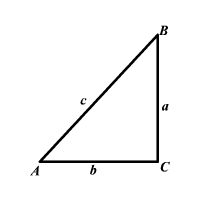
We can test this by contradiction.
Let America assume that in and the triangle is not a right triangle.
At present consider some other triangle . We construct so that , and is a quadrant.
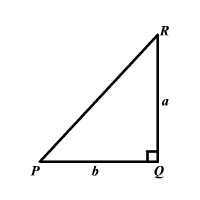
By the Pythagorean Theorem, .
Merely we know that and and .
So, .
That is, .
Since and are lengths of sides, we can take positive direct roots.
That is, all the three sides of are congruent to the ternion sides of . So, the two triangles are congruent by the Lateral-Side-Broadside Congruence Dimension.
Since is harmonious to and is a right triangle, must too be a right triangle.
This is a contradiction. Consequently, our supposal moldiness be wrong.
Example 1:
Check whether a trilateral with side lengths cm, centimetre, and cm is a right triangle.
Match whether the square of the duration of the longest side is the sum of the squares of the other deuce sides.
Hold the converse of Philosopher Theorem.
Since the square of the length of the longest side is the sum of the squares of the other two sides, by the converse of the Pythagorean Theorem, the triangle is a right trilateral.
A corollary to the theorem categorizes triangles in to acute, right, operating theater obtuse.
In a triangle with side lengths , , and where is the length of the longest go with,
if past the triangle is discriminating, and
if then the Triangulum is obtuse.
Example 2:
Halt whether the triangle with the side lengths , , and units is an acute, far, or obtuse triangle.
The longest side of the triangle has a distance of units.
Compare the square of the length of the longest side and the sum of squares of the other two sides.
Square of the length of the longest lateral is sq. units.
Kernel of the squares of the strange two sides is
That is, .
Therefore, by the corollary to the converse of Pythagorean Theorem, the triangle is an obtuse Triangulum.
8 1 practice the pythagorean theorem and its converse
Source: https://www.varsitytutors.com/hotmath/hotmath_help/topics/converse-of-pythagorean-theorem

Posting Komentar untuk "8 1 practice the pythagorean theorem and its converse"